


Nobody talks about what's actually inside your sheet mask
The sheet mask industry is worth $500M and growing. Most of what fills those foil packets is something the industry would rather you never look up.
Here's everything they're not saying, and why we do it completely differently.
The industry secret
Let's start with something uncomfortable. When you pick up a sheet mask at the drugstore, even a "luxury" one, you're most likely looking at a piece of synthetic non-woven fabric soaked in a solution that was batch-manufactured, sometimes months earlier, in a factory producing tens of millions of units a year.
The sheet itself is often made from polyester, nylon, or rayon. You know what they are? Petroleum-derived materials that don't biodegrade and have no biological affinity with your skin. They sit on your face like a wet bandage.
The essence inside? A baseline of water, a cheap humectant (usually propylene glycol), a preservative system strong enough to keep the formula shelf-stable for two years, fragrance to mask the smell of all of the above, and maybe a meaningful percentage of the one "hero ingredient" on the front of the package.
"Brightening Vitamin C mask" 0.05% ascorbic acid. Just enough to put it on the label. Not enough to do anything.
 And here is the part that nobody in the industry wants to talk about: the sheet substrate matters as much as what's in it.
Absorption, occlusion, skin-to-sheet contact, biodegradation, all of it is determined by what the sheet is actually made of. Polyester doesn't care about your skin. It holds liquid until you peel it off, then it goes straight to landfill.
Why we built something different
I formulate and fill every sheet mask in my apothecary. By hand. In small batches.
When you're not producing 10 million units at a time, you don't need a preservative system aggressive enough to survive shipping delays, warehouse storage, and a two-year retail lifespan. When you're not sourcing ingredients by the pallet from the cheapest available distributor, you can hold every ingredient to a higher standard.
And when you care about what happens after someone throws away the packaging, you choose a sheet that gives something back to the earth instead of poisoning it.

Our masks are made from biocellulose — fermented coconut fibers. This is not a marketing upgrade from regular cotton. It is a fundamentally different material category, and the difference matters at the cellular level.
 Biocellulose is grown through bacterial fermentation, the same biological process your grandmother used to ferment food. The resulting material is a three-dimensional nanofiber network with a structure remarkably similar to the extracellular matrix of human skin. It doesn't just hold serum against your face. It speaks a language your skin already understands.
When it ends up in your compost bin, it disappears. Not in 500 years. In weeks.
Our ingredient standard
Each ingredient in a MĒNOS sheet mask carries a certification trail, not because a retailer required it, but because I required it of myself before I would put it on someone else's skin.
- Fair Trade Certified
- Sustainably Sourced
- USP Grade
- RSPO Certified
- Kosher Certified
- Certified Organic
USP grade means pharmaceutical-grade purity, the same standard used in medicines, not cosmetics.
RSPO certification means no palm oil derivatives from deforested land.
Fair Trade means the farmers and harvesters who grew these ingredients were paid fairly for their labor.
These are not certifications that happen accidentally. Each one requires active vetting, relationship-building, and a willingness to pay more.
The mass market decided long ago that consumers wouldn't notice or care. I don't believe that. I think we've been conditioned to accept less because we didn't know what more looked like. Now you do.

Founder & Formulator
Read more

When we formulate at MĒNOS, every ingredient earns its place — scientifically, philosophically, and in terms of what it asks of the nervous system and skin together.
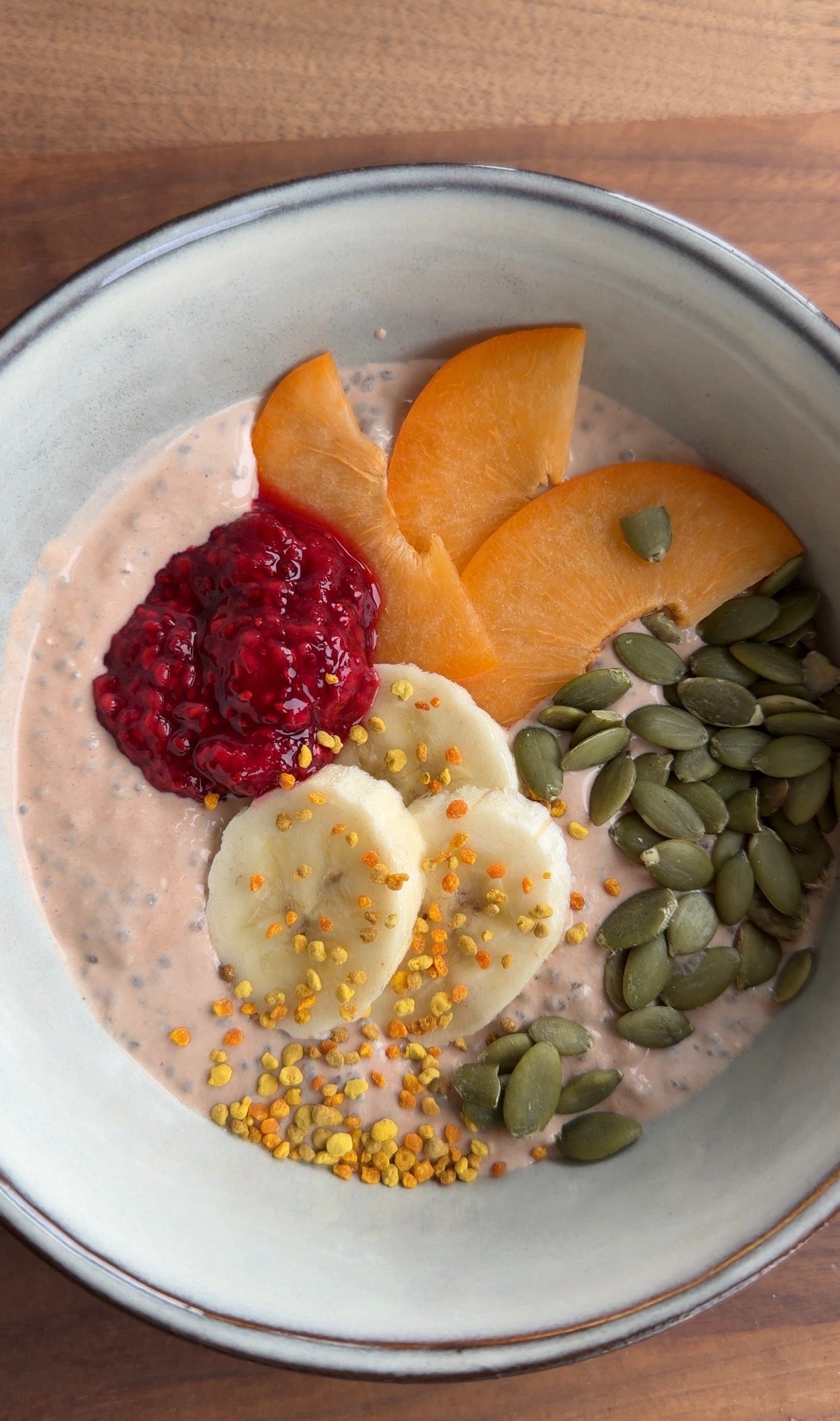
This is a bowl I come back to again and again because it does double duty. It steadies my nervous system and it's genuinely kind to my gut.